Open post Photographs mounted on wood panels

Mounting photographs on panels, an investigation

Here’s what’s happening at the studio today: I’m on a quest to liberate photographs from mattes and glass.

Yes, I am aware that’s the traditional way to present photographs. But I hate the way glass separates the viewer from the photograph. We’re often looking at a reflection of ourselves while we look at a framed photograph, but don’t realize it. I don’t want that reflective barrier, so I’m exploring alternatives. Today’s alternative is mounting prints on wooden panels.

Right now I’m protecting the mounted prints with several coats of varnish. This is one silver gelatin print and one pigment print. Can you tell which is which? I’m using matte medium for the mounting and spray varnish for protection from the environment. So far, so good. I’ll keep an eye on these for a good long while to see how they hold up. If it works, I’ll have another way to present my photographs that doesn’t involve mattes and glass. Fingers crossed!

The darkroom where I learned to print

Photo courtesy Kent Miller, kentmillerphotography.com


Here’s a photo of me in the darkroom in my childhood home, where I learned to print.

Three years ago, my brother-in-law, Kent Miller, showed up for a family gathering with fresh chemistry for the darkroom and a box of paper. I hadn’t been in there for a decade. I thought I was done with it. But there’s something special about the red lights, the sound of water and the fan. Lots of time to think while waiting for the timers. Apparently, darkroom wasn’t done with me. Thank you Kent for getting me back in here. And thank you also for this beautiful photo of a new beginning. 

Tacita Dean on Film

Tacita Dean has been an advocate for film’s future in cinema. I love this long quote from her from a recent episode of the Kodakery. She’s talking about cinema, but it applies just as well to making still photographs.

"…for me it has to be this organic medium which is film. You know, it’s about time. It’s so much about time. It’s so much about the the movement in the frame. It’s so much about the the grain to some extent and so much also what I don’t know I’m going to get but then get. It’s the mystery. It’s the it’s the blindness. When I film something and then it goes off to be processed … there’s this forgetting that happens. You forget what you found to some extent. And then there’s this moment when you see it again. But the thing again, between the forgetting and the thing again, is this huge area of creative thinking that is quite difficult to explain without sounding crazy. But it’s a really important part of the whole thing is the lack of immediacy."

The quote continues in the podcast, and the entire interview is available in the very first episode of the Kodakery. She speaks poetically about the reasons she uses film.

I love her idea of the blindness built into film photography. It’s true for me as well. Rediscovering my negatives after a time away is so useful. She doesn’t mention it, but it requires maintaining an attitude of discovery throughout the entire process, from the moment of exposure to the production of the final print.

Large format photography with paper negatives

I get a lot of questions about how this large format photography thing works. Here’s a short explanation of the process.

The photography that I do with these large format cameras is very similar to the way photography was at it’s invention (minus the corsets and top hats.) Cameras that look like mine first appeared about 1850.

Compared to modern cameras, these are quite simple. You only need a light-tight box with a lens in one end and a film holder in the other. Large format cameras don’t have autofocus or automatic metering. It’s manual all the way.

Unlike roll-film cameras or today’s digital cameras that can take many pictures between loading films (or changing cards), large format cameras shoot one piece of film at a time. A new piece of film must be put in the camera for every exposure.

The camera (pictured above) that I used to make “Twin Arches, 12 November 2016” (below) is a Century Universal 8×10. It’s a pre-WWII camera, probably manufactured sometime between 1926 and the start of the war. This is the same camera model that Ansel Adams and Edward Weston used in the ’30s. It makes a negative that is 8 inches by 10 inches.

Twin Arches, 12 November 2016

This particular model is considered a “lightweight” camera. It only weighs about 10 pounds. Shooting with it feels like carrying around a delicate piece of antique furniture. I customized a backpack so I can carry it on my back, and once I throw a sturdy tripod over my shoulder I’m ready to go. This is what qualifies as a “mobile” setup for large format photography.

I make my negatives by exposing photographic printing paper in the camera. Once developed in the darkroom, this creates what is called a paper negative. The tones of the original scene are reversed in the negative. Bright things become dark on the paper, and dark things become light. The paper reacts to light in a very similar way to the way films of the turn of the 20th century. It is pretty slow, and doesn’t record reddish colors very well.

Even though I’m using fresh materials that are currently being manufactured, I am in a sense doing antique photography. The process and materials are very similar to dry plate photography, which was invented in 1871.

My printing process with these images is similarly antique, also dating from photography’s first invention. I make contact prints from my paper negatives instead of enlargements. The process is called contact printing because I squeeze the negative face down in contact with the sheet of silver-gelatin printing paper and shine light through it to print the image into the paper. The print is exactly the same size as the negative. (This is why I use big cameras!)

I make prints in a traditional darkroom, with red lights and the sound of running water. It’s exactly as much of a refuge as you might imagine. The time I spend in the dark waiting to see the image is incredibly useful. During those waiting times, I’m usually pondering my hopes and dreams for the print I’m making, trying to clarify what I want it to say about the world.

Shots 140: Forces of Nature

Can’t even believe it. This is my photograph, Annular Eclipse, 22 September 2017, on the cover of the most recent Shots, issue number 140, entitled Forces of Nature.

Shots is a special magazine. It’s like nothing else on the newsstand. The publishers don’t give a damn about how well known your name is or what equipment you use. They just look for good black and white photographs and publish them in the best, most affordable way they can.

The magazine has been around for over 30 years. It was originally a weirdly large, single-color, newsprint magazine. Dan Price, the founding publisher, published it out of his house, which was actually a tipi. Dan would publish the photos along with whatever envelope they arrived in so you could contact the photographer if you wanted to. This was all pre-internet, you see. A much younger me used to look at the issues on magazine rack at Tower Books on South Street in Philadelphia. I didn’t have a lot of money at the time, but I did manage to collect a small stack of issues.

This older me is so honored to be on the cover. Thank you to publisher Douglas Beasley and editor Elizabeth Flinsch for putting me in my favorite photography magazine.

And while you’re here, I’m going to recommend that you subscribe to Shots. A year (four issues) only costs 29 bucks. As a magazine that consistently publishes great black and white photographs, it’s totally worth it.

But Shots isn’t just a magazine, it’s also a community. Your subscription also entitles you to submit up to 8 images to each issue for free. Compare that 29 bucks to the submission fee for the last photo contest you entered. You should subscribe now.

Douglas Stockdale: Middle Ground

This morning brought an interesting project by Douglas Stockdale. He’s made a book of photographs shot out the window of his car. Yes, normally, that’d be yawn-inducing. But in this case, the photographs are fascinating and I feel a sort of kinship in his consideration of mundane manufactured landscape. Also, his titles are really nice. It’s too easy to get weird when titling this kind of quiet work. Stockdale keeps them feeling grounded even when he’s talking about big stuff.

Aline Smithson has a great writeup on the book, entitled Middle Ground, over at LENSCRATCH. Go see the photographs and the presentation of the book, which is one continuous, fan-folded sheet.

Stockdale is represented by Fabrik Projects in Los Angeles, USA.

MQ Base, a flexible black and white photographic print developer

Note: a more refined version of this recipe, called MQ Flex, will be included in the upcoming fifth edition of The Darkroom Cookbook, by Steve Anchell. Many thanks to Ian Grant for the technical vetting and advice.

MQ Base is a three-part photographic paper developer based on metol and hydroquinone (MQ). The developer is in three parts to maximize its flexibility. Follow the instructions below to mix the stock solutions. Then combine varying amounts of MQ Base, carbonate, bromide and water to make these tray-strength developers:

  • Kodak D-72 (a.k.a. Dektol)
  • Kodak D-52 (a.k.a. Selectol)
  • Defender 55-D (a warmtone developer)
  • SA Warm-tone (another warm tone developer from Steve Anchell)

Separating the accelerator (carbonate) means that MQ Base can also be used for divided development.

Stock solutions

Prepare the following three stock solutions and store them in separate bottles. A liter of MQ Base stock keeps for at least 3 months in a brown glass bottle. The carbonate and bromide solutions keep indefinitely.

MQ Base

Distilled water at 125F/52C:  800ml  
Metol:                          3g  
Sodium sulfite, anhydrous:     45g  
Hydroquinone:                  12g  
Distilled water to make:     1000ml

6% carbonate solution

Distilled water:                 750ml  
Sodium carbonate, monohydrated:    60g  
Distilled water to make:        1000ml  

10% bromide solution

Distilled water:              400ml 
Potassium bromide, anhydrous:   50g 
Distilled water to make:      500ml 

Working strength dilutions

Dilute the MQ Base solutions as follows. Each dilution yields 1 liter of working developer.

D-72 (Dektol)

MQ Base stock:   333ml  
6% carbonate:    444ml  
10% bromide:       7ml  
Distilled water: 216ml  

D-52 (Selectol)

MQ Base stock:   167ml  
6% carbonate:     95ml  
10% bromide:       5ml  
Distilled water: 733ml  

Defender 55-D

MQ Base stock:   278ml  
6% carbonate:    250ml  
10% bromide:      43ml  
Distilled water: 429ml  

SA Warm-tone:

As 1:1 dilution:

MQ Base stock:     250ml  
6% carbonate:    127.5ml  
10% bromide:         5ml  
Distilled water: 617.5ml  

As 1:3 dilution:

MQ Base stock: 125ml  
6% carbonate: 64ml  
10% bromide: 3ml  
Distilled water: 808ml  

Note: This is not an exact match for Anchell’s SA Warm-tone. SA Warmtone has a teensy bit more hydroquinone (4.2 grams per gram of metol) than MQ Base (4.0 grams per gram of metol.) In 1:1 working solution, this difference amounts to 5% less hydroquinone.

Get in touch

If you try MQ Base, please let me know how it goes for you.

References

When formulating MQ Base, I used the recipes for Kodak D-72, Kodak D-52, and Defender 55-D from Steve Anchell’s The Darkroom Cookbook. The recipe for SA Warm-tone came from Anchell’s Variable Contrast Printing Manual. Special thanks to Mr. Anchell for preserving and sharing these formulas (and many others!)

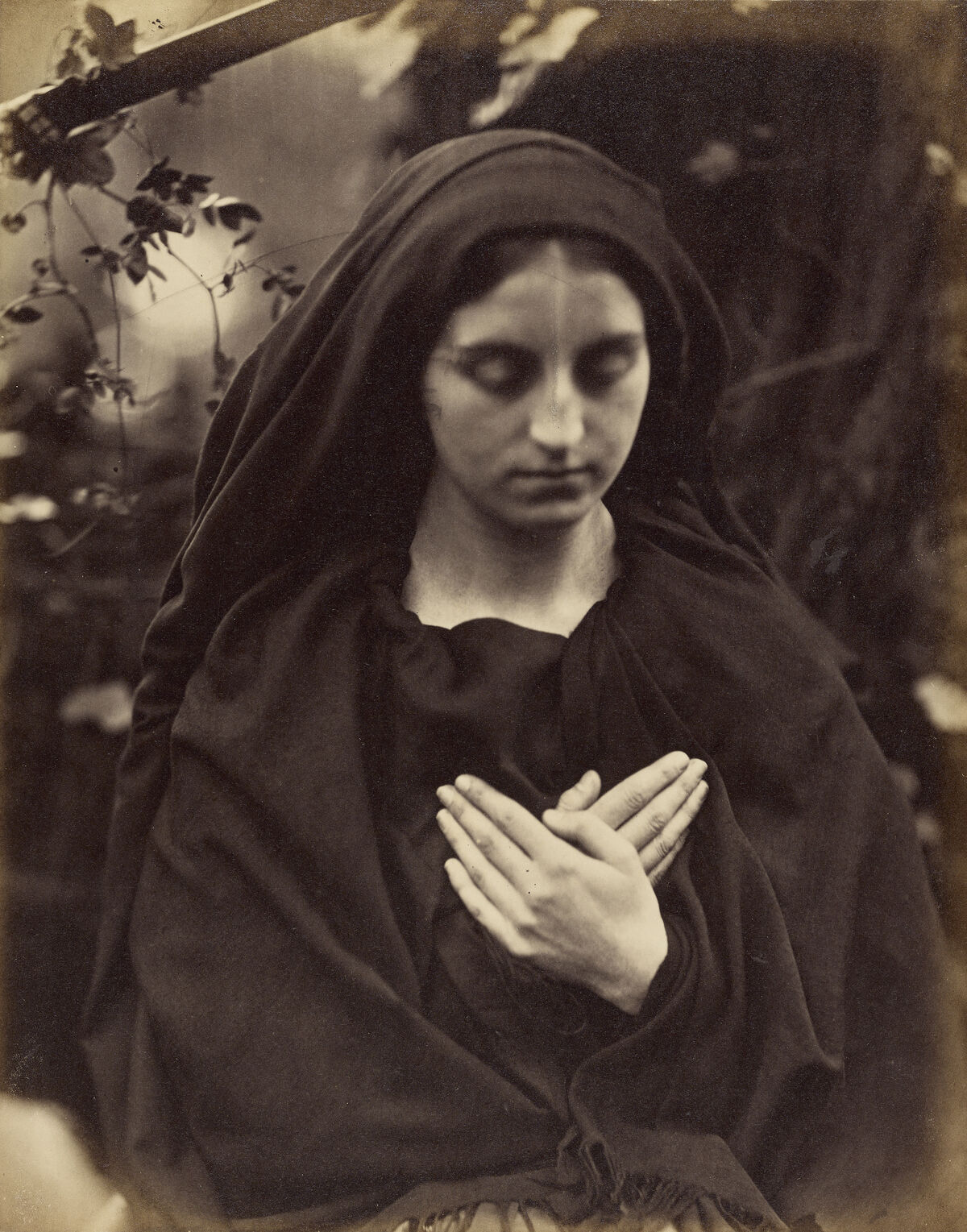
Julia Margaret Cameron, fellow lover of terrible equipment

Here’s an interesting post from Artsy about how three Victorian women photographers influenced photography and painting. It’s a fascinating article and not too long. I am glad that these photographers are still relevant.

I’m also glad to read modernist lion Beaumont Newhall criticizing Julia Margaret Cameron’s work: “She ‘used badly made lenses to destroy detail, and appears to have them specially built to give poor definition.’” (The History of Photography: From 1839 to the Present.) He says it like it’s such a horrible crime.

Cameron also apparently treasured imperfections like spots, pinholes, and abrasions. She sure sounds like someone I’d love to hang out with. For me, the imperfections are perfect, making the photographs even more true by accepting the natural ambiguity of life.

Julia Margaret Cameron, Il Penseroso, 1864. Photo via The J. Paul Getty Museum.
Julia Margaret Cameron (British, born India, 1815 – 1879)
Il Penseroso, about 1864, Albumen silver print
25.4 × 20 cm (10 × 7 7/8 in.)
The J. Paul Getty Museum, Los Angeles

Don’t Take Pictures: Structure

I’m so pleased to announce that Don’t Take Pictures has selected my photograph, Ducts, for their Structure exhibition on their web site.

Most of us spend the majority of our days inside of buildings. More than strictly shelters, the architectural styles and details of buildings show different geographic, cultural, and historic aspects of our world. From institutions of learning to places of worship; residential dwellings or the workplace; inhabited or abandoned, for this exhibition, Don’t Take Pictures presents photographs of architecture from around the world.

The collected work is really great and I’m proud to be included. There’s also a lot of urban landscape in there, and that really gets my motor running.

The exhibition is up through 21 August 2018.

Scroll to top